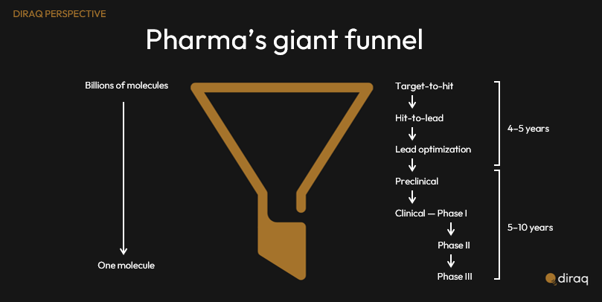
The process of drug discovery begins with the target-to-hit stage: the task of finding a protein that’s implicated in a disease like Parkinson's and then searching for a molecule that interacts with that target in exactly the right way.
Classical computers already do the heavy lifting here, sifting through millions of candidate molecules before a single compound is even synthesized in the laboratory. Most of these molecules are discarded almost immediately, and those that survive face increasingly demanding tests.
Next up is the hit-to-lead stage, where researchers attempt to separate genuinely promising drug candidates from molecules that merely looked good on paper. By the end, only a small number of molecules remain worthy of serious attention.
Then comes lead optimization, where researchers modify molecules, synthesize them, test them experimentally, analyze the results, and repeat the process over and over again. The aim is to create a molecule that works, but is also safe, stable, manufacturable, and capable of surviving the long journey through clinical trials.
This is where the economics becomes brutal. Every successful drug stands on a mountain of discarded molecules, abandoned candidates, failed experiments, and unsuccessful clinical trials.
Enter quantum
The potential value of a better computer model is to help researchers make better decisions sooner in the drug discovery pipeline. The difficulty in improving these decisions is that the underlying chemistry is extraordinarily hard to calculate, and this is because of (you guessed it) quantum mechanics.