Could Quantum Fix AI’s Energy Problem?
AI has made the relationship between computing power and energy consumption impossible to ignore. The power draw of an AI rack ranges from around 30 kW to more than 100 kW per rack, with some new models expected to exceed 1 MW, consuming more electricity in a single day than an average US home uses in two years. Globally, electricity generation supplying data centers is projected to grow from approximately 460 terawatt-hours (TWh) in 2024 to more than 1,000 TWh in 2030.
Quantum could eventually reduce the energy required for some of the hardest computational workloads, but whether it does depends heavily on how the quantum computer itself is built. To understand why, it first pays to understand what quantum computers will be good at.
The third bucket
Quantum computers are expected to be enormously powerful for certain tasks that broadly fall into three buckets:
Simulating systems that are driven by quantum mechanics,
Optimizing systems that are extremely complex and interconnected, and
Creating high-quality training data for AI.
The first two buckets include problems like designing molecules that could be effective therapies for untreated illnesses, or optimizing power grids that become increasingly complex as they incorporate power from different sources. They get a lot of airtime when people talk about applications for quantum. Read our white paper if you haven’t heard enough about them yet.
The third bucket doesn’t get discussed nearly as much, but the idea is pretty simple: because classical computers struggle with the first two groups, we don’t have great data to train AI models to help us with these tasks. And here’s where AI’s current energy problem shows up.
AI’s expensive ambition
Quantum computers will be able to fill the training data gap. For specific problems that become prohibitively expensive to model classically, a utility-scale quantum computer could perform calculations that would otherwise require enormous amounts of classical compute, effectively replacing the AI racks that are being used to generate approximate training data. But while we wait for a utility-scale machine, AI workflows are consuming huge amounts of energy to perform the tasks that quantum computers will be able to do with ease.
This doesn’t mean that the GPUs will be redundant when utility-scale quantum computers come online. Quantum computers will work alongside classical systems, with GPUs and other processors handling orchestration, error correction, AI workloads, and the many computations quantum machines aren’t designed to perform. But we’ll be able to stop using AI for the brute-force calculations that quantum can cover and that should slash power consumption.
Using AI for these tasks is like lighting up an entire stadium when a single torch would do. Of course, it matters which kind of ‘torch’ you use, and as we’ve covered on Substack before, silicon spin qubits are by far the most energy-efficient of the qubit modalities.
All quantum computers are not created equal
Quantum does not automatically mean energy efficient.
Every architecture must reach millions of physical qubits to run error-corrected workloads, but they’ll get there in different ways. For example, superconducting and photonic machines scale largely by multiplying the equipment around the qubits, which is why their roadmaps to millions of qubits imply vast cryogenic or optical plants, with the footprint and power draws to match.
Diraq’s approach uses extremely small silicon spin qubits, which are formed by modifying the basic transistor found on all modern computer chips. This means we can use the semiconductor industry’s decades of development to put millions of our qubits on a chip roughly the same size as the one holding eight today. Achieving such high density means that we don’t need to scale by multiplying the surrounding infrastructure, and this keeps our systems compact, power-efficient and practical to deploy.
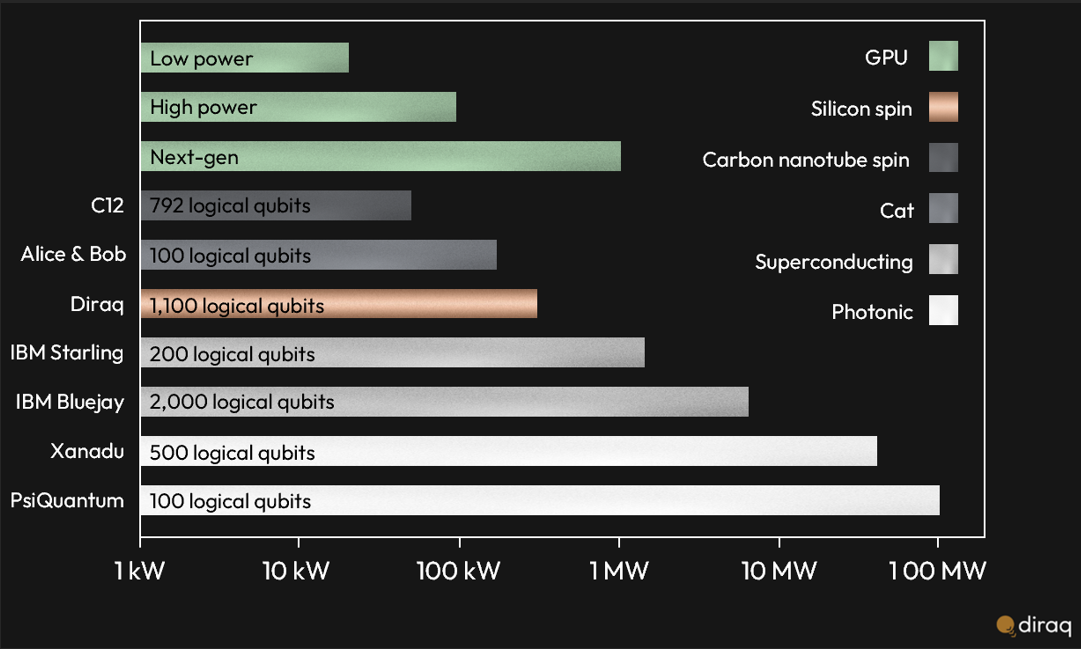
At utility scale, the quantum unit in our system is expected to draw around 125 kW. Together with the classical compute needed to interface with it, this brings the full system to roughly 300 kW. This future-system target reflects the need to combine fast quantum operations with the power, footprint and operating requirements that customers and data centers can support.
So how does that compare? Olivier Ezratty, who co-founded the Quantum Energy Initiative, has collected some telling insights about the probable power consumption of other utility-scale quantum computers, based on his meta-analysis of data from various vendors, which was posted here. At the time of publication of these data, Diraq hadn’t yet made its numbers public in The Case for Silicon, so we’ve added Diraq’s newly published utility-scale target to those estimates, alongside current and projected GPU rack power.
We’ve listed the logical qubit numbers that Ezratty reported here, together with the number that we expect to yield by 2031 using the surface code. But as we’ve discussed before, more advanced codes like qLDPC will give rise to up to 10,000 logical qubits for our utility-scale system.
What’s clear in this chart is that some modalities will consume a tremendous amount of power, and others will dip below the power draw of next-generation GPUs. Distinguishing these modalities then becomes a task of comparing other metrics, such as manufacturability, but we’ve also discussed that before.
Scaling qubits without scaling power
The Diraq system now being installed in a commercial data center is designed to draw even less power — under 20 kW for the complete quantum system. This is equivalent to the low end of the range for a standard AI rack. In this system, the cryogenic cooling and control electronics are self-contained, allowing the system to operate alongside conventional computing equipment today rather than in a purpose-built quantum facility.
This deployment is a deliberate step on Diraq’s product roadmap but not a claim of computational advantage. The deployed system contains eight qubits and has not been designed to outperform a rack of GPUs on a commercial application.
Instead, it delivers an installation model: a bill of materials, detailed technical specifications, clear operating procedures, and the security and site standards a host facility will expect, each validated against tested requirements for power, cooling, networking, and remote operation.
Because this platform is field-upgradable to devices with hundreds of qubits, the same enclosure and operating model carry forward as the processor scales, and each installation informs the next. The utility-scale system containing millions of qubits will have an even smaller footprint than our first deployment, because it won’t require engineer access.
Infrastructure is part of the bill
Power draw is usually measured at the system level, but the infrastructure that houses the system is part of the product for some qubit types, simply because they can’t be installed in existing facilities.
Quantum technologies that require purpose-built facilities will demand significantly more power than a technology that can slot into existing infrastructure, such as a data center. And that gap opens well before the first qubit is initialized.
Building a new facility means concrete for the foundation, steel for the frame and copper for the power distribution and cabling, not to mention the machinery required to piece it all together. These materials are energy intensive to produce. As an example, cement production is responsible for around 6% of global carbon emissions and steel manufacturing for around 8%.
Add the trucks that haul the material to site, the excavators and pumps that lay the foundation, and the cranes that lift the frames into place, and the emissions attached to the building are substantial before the quantum computer is even switched on.
The most energy-intensive component of a quantum product might not be the system at all, it could be the facility built to house it. A system that fits inside a facility that already exists avoids the construction bill entirely: no new foundation, no new frame, and no embedded emissions to carry over the life of the machine.
The bottom line
Quantum computing will ultimately be judged by the problems it solves, but it will be adopted according to the economics of delivering those solutions. Just as data centers are being called out over their energy use, quantum systems will face the same scrutiny. To pass this test, quantum systems will need to deliver more valuable computation without requiring proportionally more power.