Customers Don't Want Qubits, They Want Answers

Quantum computing has two separate economics: the cost of building the machine, and the cost of running it. In our previous Substack, One Dollar Per Qubit: The Number That Changes Everything, we explored how manufacturing qubits from silicon drives down the cost of building a utility-scale quantum computer. This story is about the other half of the equation, the cost of actually using it.

The quantum industry currently measures itself in qubits. This number leads press releases, anchors roadmaps, and investors are invited to read a bigger count as a stronger hand. But customers don't buy qubits, they buy answers. And the number of qubits tells them surprisingly little about what those answers will cost. The better metric is throughput: the number of quantum operations a system can execute at the logical level every second.

No one builds a data center today by counting a chip’s transistors. They measure the work it can do and what that work costs. For AI, that work is measured in tokens, and quantum computing needs the same correction.

If you take away two lessons from this article, make it these:

1)    You can calculate the cost of a single logical quantum operation and use it to price any quantum algorithm.

2)    This very useful number is not the same for every quantum system. And as you’ve probably already figured out, silicon spin qubits fare well by comparison.

The unit is the operation

An algorithm demands a certain number of reliable logical quantum operations to reach its answer, but that demand belongs to the problem rather than the machine. For example, simulating a super-efficient carbon-capture material demands a certain number of logical operations, whereas optimizing the engineering of lithium-ion batteries requires a different number.

Neither number changes because a vendor announces more qubits. The only way to reduce that number is through algorithmic improvements. A better algorithm for the same problem requires fewer logical operations, regardless of which quantum machine runs it, and different machines perform operations at different rates.

Divide the cost of running the machine per second by the number of logical operations it can process in a second and you reach the number that decides whether a use case is a business: the cost of a single logical quantum operation. Qubit count does not vanish from this picture, but it’s no longer the headline. It’s just one input needed to determine what it actually costs a particular machine to produce an answer.

Two gates to payday

A problem only becomes a business after it clears two gates.

The first is feasibility. For every algorithm, there is a minimum number of error-corrected, or logical, qubits that is required to represent the problem. A machine with a logical qubit count below this threshold simply cannot run the algorithm — no matter the speed or price.

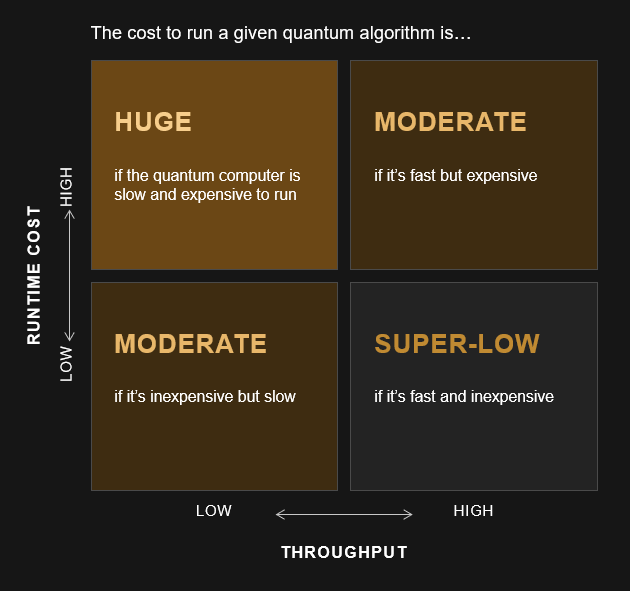
The second gate is runtime and, by extension, cost. A computation that clears the feasibility gate still has to finish inside a time window that someone is willing to pay for. A result in three days is a service. The same result in nine centuries is… well, less commercially useful. Because operating cost is runtime multiplied by the machine's hourly rate, once you’ve fixed the acceptable runtime, you’ve also fixed the maximum price you need a customer to pay.

What does this look like in practice?

Diraq has run preliminary calculations on the rate of logical operations we expect to achieve with our utility-scale systems using a quantum low-density parity-check (qLDPC) error-correcting code, like the one reported earlier this year by our partner Iceberg Quantum. Once you’ve run these calculations, you can start putting price tags on problems instead of on machines.

Many simulations of new materials or the unknown physical behaviors of solids can’t be performed by classical computers. On a utility-scale quantum computer, they become both possible, and also remarkably inexpensive (for some modalities). Using a Diraq system, the standard models of high-temperature superconductivity and correlated electrons finish in under an hour, with costs ranging from a few dollars to a few thousand.

Simulating the quantum chemistry processes needed to improve solar cells costs a few thousand dollars and runs in hours. Even the FeMoCo cluster, the catalyst that underpins global fertilizer production and is famously difficult to simulate, becomes a job requiring 285-trillion logical operations, which can be completed on a Diraq machine in a matter of weeks for a couple of million dollars.

Every modality faces to the same test

Throughput depends on two things: how many usable logical qubits a machine has, and how quickly it can perform logical quantum operations. Trapped ion and neutral atom systems process logical operations more slowly than other modalities, which limits how much work they can get through in a given amount of time.

One way to increase throughput is to add more qubits, allowing more operations to happen in parallel. But those additional qubits have to be added at a decreasing per-qubit cost to maintain the system’s price. And even with more qubits, the machine still has to finish commercially valuable problems within a useful timeframe.

Superconducting systems are fast, putting them in the same speed class as silicon spin qubits, so speed is not the main challenge. Their constraint shows up as cost, and photonic qubits have the same problem. As these systems scale, the cooling, control, and supporting infrastructure required to operate them also grows, pushing up the cost of running the machine.

The stake in the ground

The cost of a logical quantum operation does not flatter every approach. It falls when the hardware is cheap to build and operate, and easy to deploy, because both feed straight into the cost of every operation the machine runs. That is why these two numbers belong together. The cost to fabricate and operate a qubit ultimately sets the price of an operation, which determines what a customer pays to solve a problem. Win the first contest and you are positioned to win the second. Build custom hardware to scale and every extra dollar spent building the machine finds its way into the price of the answer.


Next
Next

Diraq Founder and CEO Andrew Dzurak Elected a Fellow of the American Physical Society