One Dollar Per Qubit: The Number That Changes Everything
The quantum computing debate is stuck on the wrong question. Everyone asks when useful quantum machines will arrive but almost nobody asks what they will cost. Cost is what decides whether quantum computing becomes a planetary-scale tool or a handful of expensive science experiments locked inside the world's wealthiest labs.
At Diraq, cost has been the protagonist from day one. Our thesis is that silicon CMOS is the only manufacturing base that can deliver millions of qubits at a price the world can afford, and this is because the cost curve will bend over time.
The Diraq Cost Curve — A Story in Three Acts
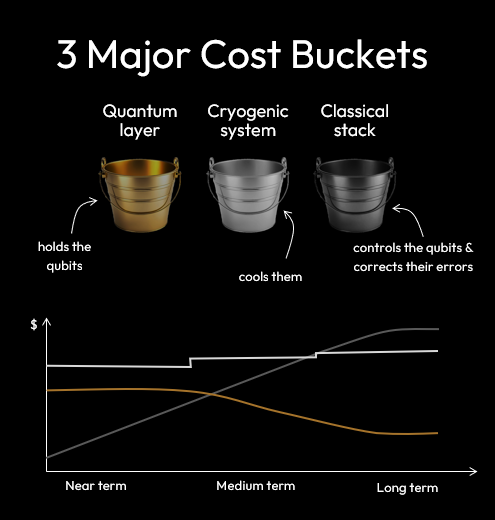
I. Cryogenics is King in 2026
Our current systems run tens to hundreds of physical qubits on a single silicon chip, cooled inside a cryogenic unit and driven by classical control hardware, some of which is designed to withstand cryogenic temperatures, while the rest operates at room temperature.
The control electronics are modest because the qubit count is modest. The quantum chip itself is expensive, but only if you’re calculating on a per-chip basis. We’re doing commercial foundry runs and only using a few of the hundreds of chips we get from a 300 mm wafer, which means we’re not yet seeing the benefits of CMOS scaling.
So the dominating cost for this version of the system is cryogenics. But it's worth pausing here on one fact that shapes everything downstream: Diraq's qubits operate at around 1 kelvin, not the 10–20 millikelvin that other platforms require. That difference alone changes the class of cryogenic cooling we need — and it's a difference that compounds as we scale. It keeps power requirements relatively low, and it means we can use a cheaper and more accessible form of helium. We covered the broader energy implications of this in Scaling Quantum While Avoiding Energy Crises.
II. Classical Compute Catches Up By 2029
As we move toward thousands and then hundreds of thousands of qubits, the cost profile shifts. The qubits still fit on one chip, and the fridge hasn’t changed much, but the classical stack has grown. More qubits means more control chips integrated directly with the qubit plane, and more classical compute for decoding quantum errors in real time. GPUs start showing up in the bill of materials in numbers that matter.
In this phase, cryogenics and classical compute converge as one plateaus, and the other rises to meet it.
III. Quantum Costs Fade Away from 2030
By the time we hit millions of qubits in the early 2030s, the cost center has moved entirely. Cryogenics is no longer the story. It's a fixed line on the bill of materials, essentially the same kit we were using in Act I, modestly upgraded. The qubits still fit on a single chip, but now we’ve optimized our foundry runs, so the price per chip is no longer exorbitant.
What costs the most now (both in dollars and in power) is the classical stack, which is made up of the decoders, the GPU cluster running error correction, and the cryogenic electronics that are in direct contact with the quantum chip.
Per-qubit cost in this phase trends toward less than a dollar per qubit.That’s what the math does when you spread a fixed cryogenic cost across ten million qubits and ride the semiconductor manufacturing curve for the rest.
It’s worth pointing out that this estimate is for the entire stack. The qubit chip itself is less than one cent per qubit, but the price of the supporting classical compute and networking (roughly $1,000 per logical qubit) drives the cost closer to a dollar per qubit.
And because Diraq’s qubits are a similar size to the billions of transistors on the chip inside your phone, there’s a plausible pathway to billions of qubits on a single chip — and a long-term path to continue riding down that cost curve.
A chip that doesn't grow and multiply
Here is the part of the story that is unique to silicon.
Our 8-qubit chip, our 100,000-qubit chip, and our 10,000,000-qubit chip are all roughly the same size. This means that the form factor of future systems will be similar to that of our current system. We don’t need to network modules together. This is a lesson in physics plus industrial history: using the same semiconductor industry proven at scale across 70 years and trillions of dollars of cumulative investment.
This concept of one chip in one fridge is why our cryogenic costs stay flat while our qubit count grows exponentially. That’s how you get a cost curve that looks like Moore’s law. It's also what makes integration into existing data center infrastructure possible — something we covered in depth in Quantum is the Next Data Center Transition.
Why we’re alone on this curve
The key differentiator is the number of qubits you can fit in one module, with each module being a cryogenic fridge, say, or a laser system. Because cost scales with the number of modules, modalities that need multi-module architectures see costs increase as they scale.
Superconducting qubits run at 10–20 millikelvin and are limited to a few thousand qubits per chip. To reach a million superconducting qubits, you need to build enormous custom cryogenic fridges (designed, fabricated, and validated from scratch) or connect many smaller fridges, each with their own cryogenic overhead. Either way, cryogenic cost scales roughly with qubit count. A fridge can cost millions of dollars, resulting in a utility scale quantum computer that potentially costs billions of dollars.
Trapped ions can reach about 10,000 qubits in a single chip. To go further, chips must be linked with photonic interconnects. Trapped ions only need moderate cryogenic cooling but they still require a cryogenic unit, and each module additionally requires a laser system and a vacuum chamber. This dominates the costs as the number of qubits increases.
Neutral atoms are held in place by laser “tweezers”. The cost barrier here is the laser system itself: at around 100,000 atoms you exhaust what today's tweezer arrays can accommodate. Each additional module needs new lasers, new optics, and a new vacuum chamber.
Photonic qubits don't need millikelvin cooling but each qubit needs many components to be packed onto the chip with it: photon sources, switches, detectors. And single photons can't be made on demand, so you need heavy redundancy. The chip fills up fast with a maximum of about 5,000 qubits. To get higher qubit counts, modules are connected with fiber, but every link adds loss, and every chip still needs its own cooling.
Infrastructure cost scales with qubit count for every serious quantum computing platform — except silicon spin qubits, for which the scaling is approximately flat. Other modalities have to pay twice to scale: once to engineer the complex electronics required to control qubits, and again for more (or much bigger, or custom-built) cryogenics. With silicon, you only pay once.
The quiet constraint
The point where a quantum computer’s commercial value exceeds the cost of running it is referred to as utility scale, and it’s usually framed in terms of having enough qubits to perform useful computations. But this is only half the equation. It's about minimizing the cost-per-useful-computation, and this cost is dominated by the scaling behavior of the infrastructure overhead.
The quantum industry still measures progress in qubit count. But the number that determines whether quantum computing reaches the real world is cost per qubit. At a dollar per qubit, useful quantum computing stops being a projection and becomes an economic reality. That is the threshold worth watching.