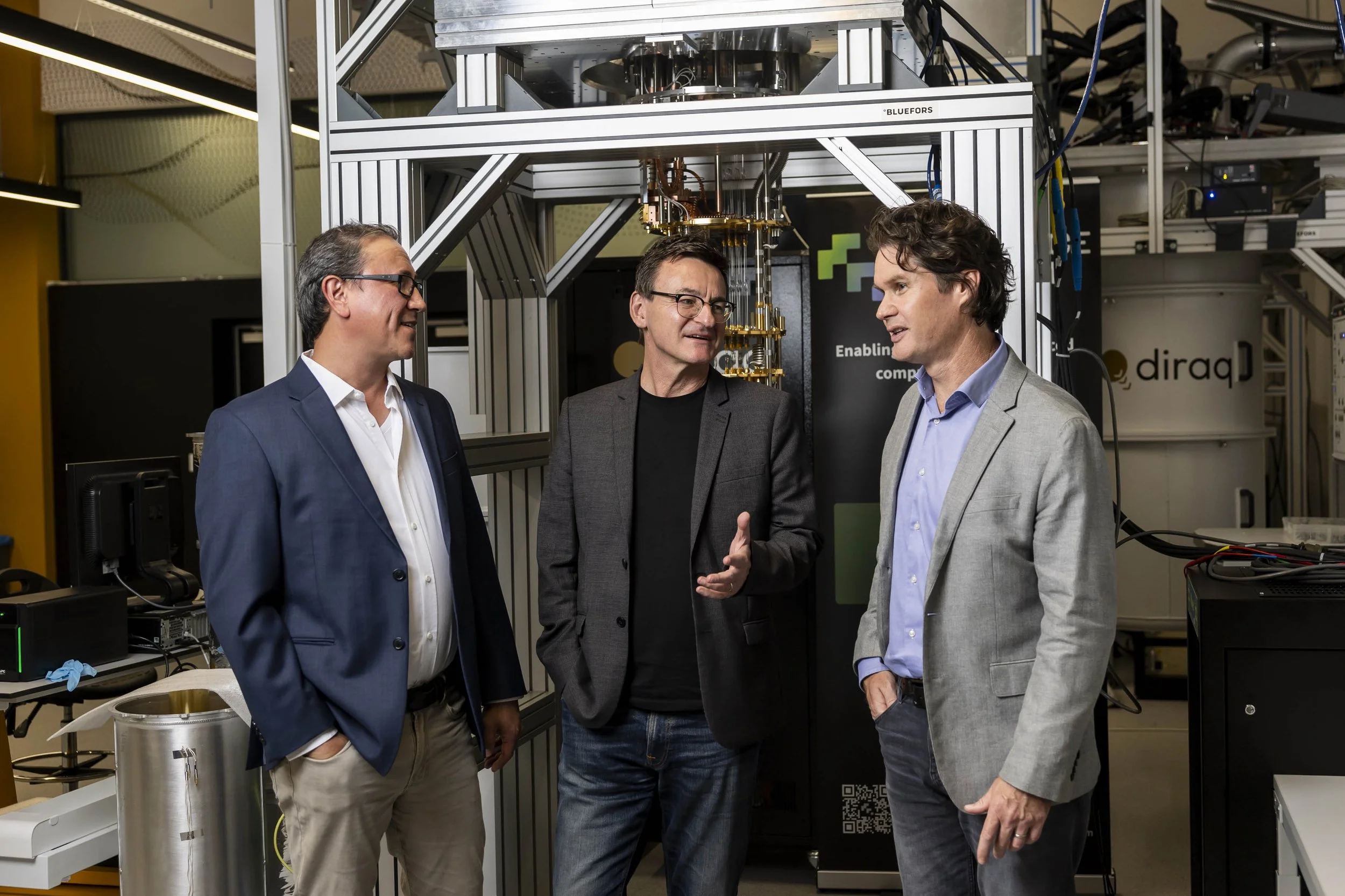
Tom Ohki, Chief Technology and Scientific Officer at Emergence Quantum, Andrew Dzurak, CEO & Founder of Diraq, David Reilly, CEO and Founder of Emergence Quantum, pictured at Diraq’s lab.
Australia has always done more with less. In quantum, it's doing more than almost anyone. Behind that sits decades of compounding talent and institutional memory, a fit-for-purpose startup ecosystem and sovereign capital invested with conviction.
In November last year, DARPA advanced 11 companies to Stage B of its Quantum Benchmarking Initiative — the US Department of Defense's shortlist for the quantum platforms that will achieve a useful scale by 2033. Two of the 11 were founded in Sydney, including Diraq, which spun out of UNSW in 2022 to build qubits on standard semiconductor chips, a design intended to put millions of qubits on a single chip and slot directly into existing data center infrastructure.
Outside this list, Australia’s quantum density is stranger still. And Diraq makes good use of this hot spot by forming strong partnerships within the ecosystem. Q-CTRL, which spun out of the University of Sydney, closed an A$166 million Series B in 2024 — the largest quantum software round in the world. Iceberg Quantum made a splash earlier this year by releasing a novel error correction architecture that could accelerate several companies’ pathways to utility scale, including Diraq. Emergence Quantum was formed from the 20-person team that ran Microsoft's Station Q laboratory in Sydney until 2024. When Microsoft offered every one of them relocation to the US, they opted to start a new company in Australia instead.
Australia is undoubtedly a great place to live, but lifestyle appeal can only do so much heavy lifting. The reason that these companies are clustered in a country of just 28 million people is that it is simply one of the best places on Earth to do quantum.
It might seem like there's something in the water, but none of this happened by accident. It took ambition and commitment. The origins of Australia's quantum vision started in 1998, when the American physicist Bruce Kane proposed a silicon quantum computer in a paper in Naturethat he wrote as a postdoc at UNSW Sydney. Kane returned to the US, but his idea remained — and Australia got to work.
The Australian Research Council funded the world's first silicon spin-qubit research centre in 2000, writing fellowships to attract global talent, and sustaining the ecosystem with roughly A$2.4 billion in public money across two decades. Andrew Dzurak, who would go on to found Diraq, was one of the researchers who built that center into a world-leading program, and who patented the first silicon spin qubit in 2014.
The money landed on a world-class research base. Nine Australian universities sit in the global top 100 — a higher per-capita density than the UK, the US or Germany. Australia now has a pipeline of expertise across the full quantum stack, from silicon spin-qubit fabrication and semiconductor device engineering through to quantum control, algorithms and software. UNSW Sydney was the first university in the world to offer a Bachelor of Quantum Engineering.
Policy and support have kept pace. The National Reconstruction Fund, Australia's sovereign industrial investor, was set up to fund critical technologies and owns a stake in Diraq.
Access to the US is another underrated advantage: the E-3 visa is available only to Australians, involves no lottery, and is indefinitely renewable. Together with the AUKUS and Five Eyes agreements, it is unusually easy for Australians to work in the US. This is a vital bridge for companies scaling offshore and has established a pipeline of boomerangs returning to Australian soil with Silicon Valley experience.
Australia’s quantum moment has converged with its data center moment. Quantum computing won't exist in isolation — it will be one layer of the broader compute infrastructure, sitting alongside classical compute and AI accelerators in the same data centers. That makes Australia's data center boom directly relevant to its quantum thesis.
As a Five Eyes and AUKUS member, Australia has relatively unrestricted, privileged access to NVDIA's top-end AI chips. This matters especially for Diraq, whose silicon spin qubit systems are designed to be integrated directly into data center infrastructure rather than requiring bespoke facilities.
Last month, Diraq was one of just 9 companies to sign a Letter of Intent (LOI) with the US Department of Commerce for up to $38 million in proposed federal funding from the CHIPS Research and Development Office. This award would support production and scaling of fault-tolerant silicon quantum-computing processors via the US semiconductor industry.
Being on the other side of the world means Australia's quantum ambition can go unnoticed. But quietly, and then all at once, Australia is out in front. For companies like Diraq, whose technology is designed to live inside the data center infrastructure now being built across the globe, that convergence is the whole point.