Improved Placement Precision of Donor Spin Qubits in Silicon using Molecule Ion Implantation
Published in Advanced Quantum Technologies
Danielle Holmes, Benjamin Wilhelm, Alexander M. Jakob, Xi Yu, Fay E. Hudson, Kohei M. Itoh, Andrew S. Dzurak, David N. Jamieson, Andrea Morello
Abstract
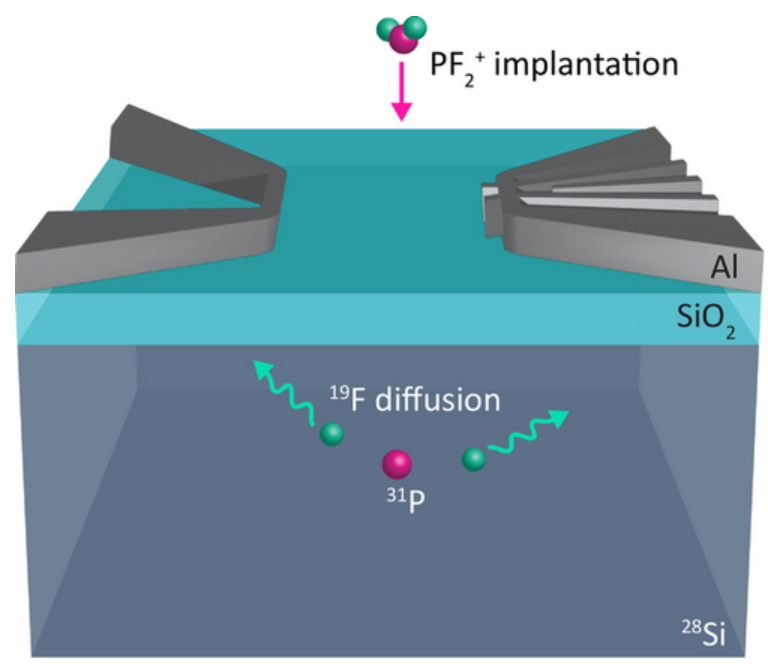
Donor spins in silicon-28 are among the best performing qubits in the solid state, offering unmatched coherence times, gate fidelities beyond 99% and the ability to fabricate arrays using deterministic ion implantation. Donor placement precision is improved upon, advantageous for qubit readout and coupling, by implanting molecule ions that carry bystander atoms to boost the detection confidence. Here, the suitability of phosphorus difluoride () molecule ions is demonstrated to fabricate donor qubits. Using secondary ion mass spectrometry, it is confirmed that (nuclear spin ) diffuses away from the implant site while remains close to its original location during a donor activation anneal. Electron spin resonance measurements are then performed on -implanted qubit devices. A pure dephasing time of and a coherence time of are extracted for the P donor electron- values comparable to those found in conventional atomic -implanted qubit devices. Additionally, the P donor electron is not found to hyperfine couple to any nuclear spins in its vicinity. Molecule ions therefore show great promise for producing high-precision deterministically-implanted arrays of long-lived donor spin qubits.