Diraq is Accelerating its Path to Utility-Scale Quantum Computing with NVIDIA Ising and NVQLink
About Diraq: Diraq is building quantum computers by modifying classical silicon transistors to control quantum information. By leveraging the mature manufacturing processes of the semiconductor industry, Diraq can put millions of qubits on a single chip, giving rise to compact QPUs with drastically reduced infrastructure requirements compared to other modalities. The company’s quantum computers can be easily deployed in data centers, enabling the hybrid quantum-classical workloads that will deliver the most valuable applications of utility-scale quantum computers.
Challenge
What Diraq needed to do
Diraq’s silicon spin qubits operate on nanosecond timescales, which makes them among the fastest qubits available. But it also presents a challenge: as the company marches toward utility scale, where the value of quantum computing exceeds its cost, it’s becoming clear that classical compute needs to match and enhance these speeds.
Quantum processors can’t operate in isolation. They will work within and alongside the supercomputers of tomorrow, requiring classical compute to orchestrate control sequences, analyze measurement data in real time, and implement the adaptive feedback loops that enable error correction and calibration at scale. These tasks all demand ultra-low-latency between QPUs and GPUs, which need to be able to respond before the quantum information degrades. Without this tight coupling, even the most advanced quantum processors will be bottlenecked by the inability to close the loop between measurement and response.
One example is calibrating silicon spin qubits, which involves identifying transitions in charge stability maps. This is a multi-dimensional tuning task that usually requires expert physicists to spend hours manually labeling measurement data and iteratively sweeping parameters. Without automation, this bottleneck would make scaling to thousands or millions of qubits operationally infeasible.
Tasks like this one permeate Diraq’s workflows, and many of them need to happen in real time. The industry status quo of analyzing data offline and designing the next experiment days later is inherently incompatible with the closed-loop control and real-time error correction needed for utility-scale quantum systems.
Constraints
Speed and latency: Diraq's silicon spin qubits need to be integrated with classical compute with microsecond-scale round-trip communication times to enable real-time feedback during live experiments.
Calibration complexity: Qubit calibration requires GPU-accelerated, vision-capable machine learning models tightly integrated with quantum experiments to turn raw measurement data into calibration signals without manual labeling.
Ecosystem compatibility: As Diraq’s systems move toward data-center deployment, they need to integrate seamlessly with the AI and HPC ecosystems already widely in use, enabling hybrid workloads without steep learning curves or bespoke infrastructure.
System Architecture
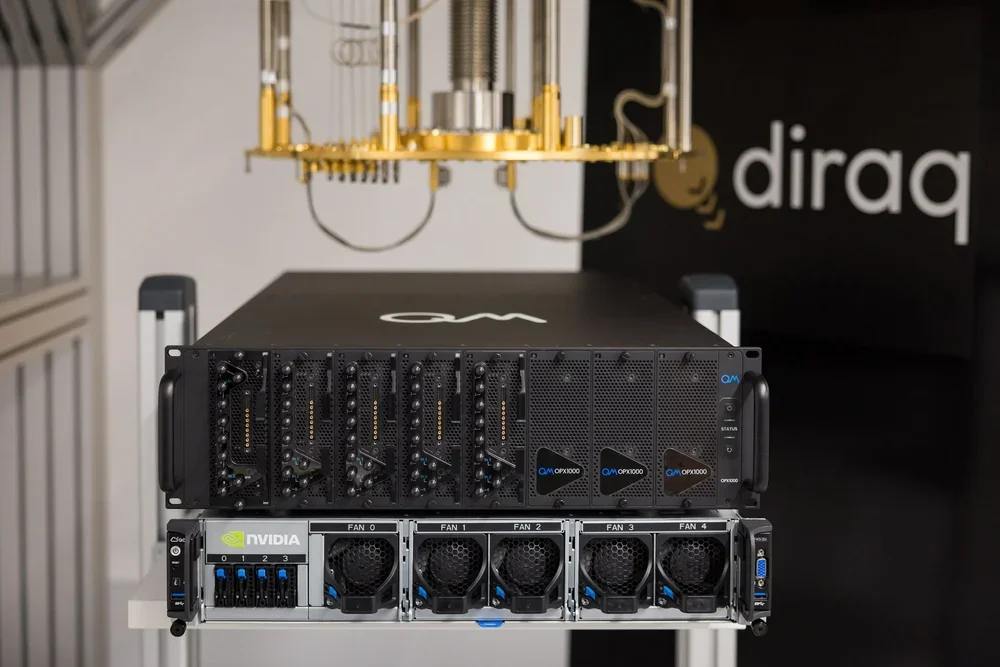
To meet these constraints, Diraq is using a hybrid quantum–classical platform that integrates silicon quantum processors with the NVIDIA GH200 Grace Hopper Superchip via NVIDIA NVQLink, achieving ultra-low latency communication of approximately 3.3 µs round-trip time.
This architecture enables real-time feedback between Diraq's quantum processors and classical compute, allowing the system to adjust experimental parameters on the fly. NVQLink serves as the critical high-speed interconnect in this scheme, coupling the extreme performance of GPU supercomputing with quantum processors to build accelerated quantum supercomputers.
Architecture Overview and Data Flow
Hybrid quantum-classical platform
The NVIDIA GH200 provides the computational backbone. Its combination of raw computational speed, programmability, and ultra-low-latency integration makes it uniquely suited to Diraq's needs. The system orchestrates quantum experiments with classical processing in a unified workflow using NVIDIA CUDA-Q.
AI and calibration workflows
Diraq is now also leveraging the NVIDIA Ising family of open models, using Ising Calibration’s GPU-accelerated AI to analyze its charge stability maps and identify functional qubits through automated image analysis.
This calibration workflow is a crucial step in initializing silicon spin qubits. By running GPU-accelerated, vision-capable models tightly integrated with experiments via NVQLink and CUDA-Q, Diraq can turn raw measurement data into clear calibration signals without manual labeling.
Integration Details
The GH200 Superchip was first integrated into Diraq’s system in May 2025. Within just one week, Diraq's team demonstrated three real-time applications addressing fundamental scaling challenges.
NVQLink provided the high-speed, low-latency link between the GH200 and the quantum control system, achieving the critical round-trip time.
Diraq uses CUDA-Q to access an NVQLink interconnect, across all workflows.
The Ising framework has now been introduced to improve the machine-learning models that calibrate qubits.
Results
Before and After Comparisons
Calibration workflow transformation: Before NVIDIA, manual calibration of silicon spin qubits would consume a year's worth of an expert physicist's time. With GPU-accelerated machine-learning models running on the GH200 and integrated via NVQLink, Diraq can now train calibration models in just days, dramatically accelerating the calibration process.
Real-time adaptive experiments: Analyzing measurement data offline means that experiment re-design takes days. Diraq can now close the loop between measurement and analysis in real time during live experiments. This feedback loop allows the system to respond intelligently to observations and tune itself in a way that evolves as the experiment runs, changing how Diraq develops and optimizes quantum processors.
Team productivity: By automating hours of manual tuning and enabling real-time adaptive experiments, Diraq's physicists and engineers spend less time on repetitive calibration sweeps or offline noise analysis. Instead, they focus on challenges that matter most on the path to utility scale, including scalable architectures and novel error-correction pathways. NVIDIA is compressing Diraq’s entire development loop.
Strategic Outcomes
"NVIDIA is fundamentally changing our route toward utility-scale quantum computing, enabling real-time feedback and high-throughput automation across our stack. NVIDIA and Diraq are ideally suited to each other too — we're the quantum and classical sides of the same coin in terms of being cost efficient and widely deployable." — Andrew Dzurak, CEO and Founder of Diraq
At the company level, Diraq's collaboration with NVIDIA reinforces its strategy of aligning with ecosystem leaders and leveraging best-in-class expertise rather than building everything in-house. By working with NVIDIA, Diraq gains access to leading-edge compute, but also to a shared language and infrastructure that simplifies collaboration with the broader AI and HPC communities.
NVIDIA's ubiquity makes it remarkably easy to engage in a thriving ecosystem of developers and integrators. Because NVIDIA platforms are already widely deployed in data centers, Diraq benefits from mature software stacks, extensive documentation, and a large talent pool that can work across quantum and classical compute.
Next Steps
Scaling Toward Utility-Scale Quantum Computing
The collaboration between NVIDIA and Diraq is only just beginning. Diraq has plans to incorporate NVIDIA's platform into more workflows, ultimately arriving at a point where Diraq's QPUs use the NVIDIA platform to accelerate AI workflows by generating training data that inform and improve classical models.
Broader Industry Impact
The quantum computing industry has moved past simply proving that quantum computing is possible. Reaching utility scale is now the defining challenge, and this means building systems that deliver real-world value while keeping operating costs low. As quantum systems are moving into high-power AI and HPC workloads, maximizing value depends on tight integration without driving disproportionate energy use or infrastructure overhead.
Compact, energy-efficient architectures with high-qubit density are essential for enabling quantum processors to sit alongside GPUs as accelerators rather than requiring bespoke facilities. Approaches, like Diraq’s, that scale through dense on-chip integration and leverage existing chip ecosystems offer a clear path to utility scale, allowing hybrid AI–quantum systems to deliver meaningful performance gains without the energy penalties that would otherwise limit adoption at scale.