Diraq’s Quantum Computers Are Boring
Quantum computing will be a general-purpose and transformational technology, the kind that reshapes how entire industries work rather than improving a single corner of one. That promise is the exciting part of this field, and it is the only part that should be exciting.
The system that delivers on it should be boring.
The most widely shared image in quantum computing is a photograph of a dilution refrigerator — the cryogenic equipment that keeps qubits ultracold. It’s that gold-plated chandelier that is usually suspended in a clean room behind glass. It is a beautiful object and has become the visual shorthand for the entire field: quantum as something rare and delicate, kept alive a fraction above absolute zero by machinery most people will never stand next to. The picture does a great deal of fundraising work. It says the future is difficult, and that capital is what stands between us and it.
Diraq is building toward the opposite picture. We are building a boring quantum computer.
What boring means
Boring means the quantum processor is a silicon chip, made with the same complementary metal-oxide-semiconductor (CMOS) manufacturing that produces the processor in your laptop, from materials the semiconductor industry has worked with for 50 years. No exotic substrate, no fabrication method invented from scratch.
The machine fits in a rack, not a room — without the football-field spread of vacuum systems and optical tables that some approaches require. It sits in a data center, right beside regular classical compute.
The cooling required for Diraq’s quantum computers is also unremarkable. Silicon spin qubits run warm enough that they do not have to sit at the absolute floor of achievable temperature, where the most fragile platforms are forced to operate. Warmer operation buys you compact, commodity cooling instead of the most exotic (and expensive) refrigeration money can build.
Diraq’s qubits operate with a classical CMOS chip, with no optical tables and no laser systems to keep aligned. Deployment looks familiar: the processor installs into existing infrastructure and is run by people who already understand silicon. This maintenance is closer to operating a server than to babysitting a physics experiment.
None of that is a miracle. Boring is what a technology looks like once it stops being a demonstration and turns into infrastructure. Boring is what wins.
The metrics that photograph well
The quantum industry rewards spectacle, because spectacle is legible to a non-specialist: a record qubit count, record qubit fidelities. Each makes a clean argument that you are ahead. By those measures, we are content to be honest. We do not hold the qubit-count record (yet), we are not first on every fidelity table. But don’t be fooled: it turns out silicon qubits have high enough fidelity to work and (more importantly) they’re built to scale, so our qubit counts will soon soar above other modalities. That’s all that matters. It’s boring, but it works.
Fidelity, across the serious modalities, is largely solved in the sense that matters. Several platforms, silicon among them, can already perform operations accurately enough to run error correction (> 99%). The axis where every approach is still orders of magnitude short is qubit count, and there nobody is close, because the machines that will matter need millions of physical qubits.
Against that target, the gap between a few hundred and a few thousand today is a snapshot of a race that has barely started, and the only question worth asking is who can manufacture their way up the curve. While leading with qubit numbers with 1,000 might sound impressive, it’s on the same part of the exponential curve as Diraq’s 10.
An impressive benchmark on a research apparatus is also not a product. It tells you what is possible in a lab, but very little about what can be built ten thousand times over and shipped. Those are manufacturing questions, and manufacturing is the boring part that the rest of the field has not yet had to confront.
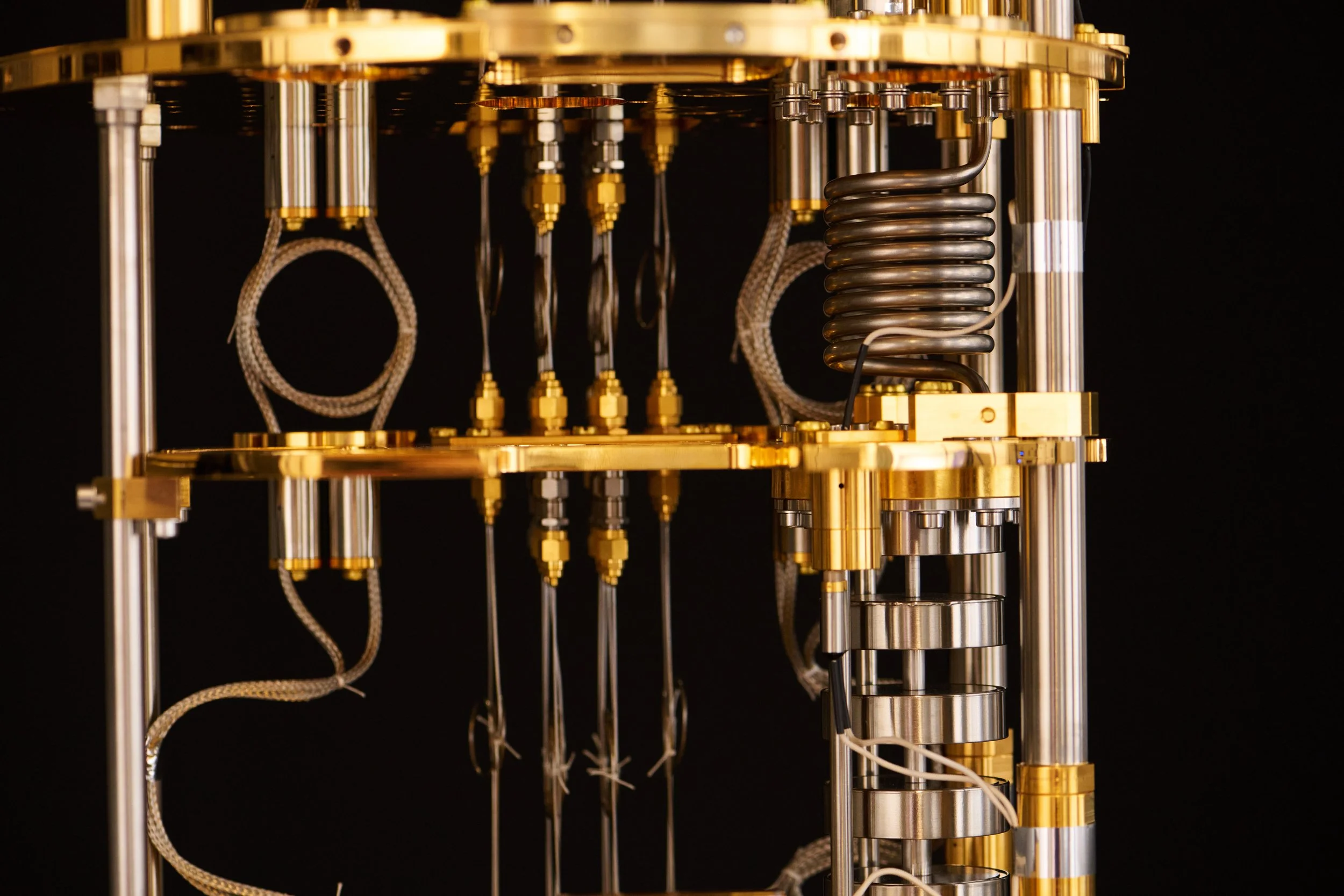
Zoom in of chandelier inside of Diraq’s cryogenic fridge
Why make the boring bet
Every approach to scaling quantum hardware is a bet on solving some difficult problem, and a useful way to compare them is to ask how many miracles each one needs to succeed.
The exotic modalities each need at least one.
Superconducting machines have to hold millions of qubits stable at a few thousandths of a degree above absolute zero. This requires networking many dilution refrigerators together, because that many superconducting qubits can’t be packed densely onto a single chip.
Trapped-ion systems work beautifully at small scale and then also need many modules networked together, a problem that is still genuinely unsolved.
Neutral-atom arrays sit inside vacuum systems and laser fields whose complexity climbs with every atom added.