One Million Qubits Is Table Stakes

Most roadmaps charting a course for useful quantum computing share a common goal: one million physical qubits, usually paired with some claim about achieving fault tolerance. But framing this number as the destination is short-sighted because it really only guarantees a seat at the table. The companies that will define the industry over the coming decades are the ones who have a clear path beyond this number. And silicon is the only quantum platform with a plausible way to replicate Moore’s Law.

How one million became the benchmark

The reason that one million qubits has become a kind of industry consensus is tied in some ways to the way that research on quantum error correction (QEC) has developed. New QEC codes are rapidly being written, but the most mature code is known as the surface code, and it needs roughly one million physical qubits to form enough logical qubits to do something commercially useful, like simulating molecules that could offer new therapies for untreatable illnesses.

To understand why this is a threshold to be surpassed, and not simply a target to hit, it pays to look further back at how the history of classical computing has unfolded. In 1971, the Intel 4004 had 2,300 transistors. Today’s flagship processors carry tens of billions, and the data-center accelerators running modern AI workloads carry more than that. Each application that has emerged — the personal computer, the smartphone, the cloud — has demanded a scale that the previous generation could not have served.

Quantum will follow the same pattern. Realizing one million physical qubits unlocks one class of problems, reaching ten million unlocks another: molecules that are ever more complex, or logistics problems with an increasing number of variables. Push to a billion, and the applications don’t yet exist to describe what becomes possible. These wide-ranging use-cases will eventually justify the capital this industry has attracted, and they’ll need scales that most existing roadmaps can’t touch.

Where other approaches hit their ceiling

Most approaches don’t even have a credible path to one million qubits. And those that do must overcome poor scaling economies to get there. Past that point, these problems will continue to worsen.

  • Trapped ion chains become unwieldy past a certain length, forcing a switch to a networking solution that is unsolved at scale.

  • Neutral atom arrays sit inside vacuum systems and optical tweezer fields with engineering complexity that grows with array size.

  • Superconducting qubits are millimeter-sized,which is massive for quantum, and sit inside dilution refrigerators that already strain at thousands of qubits.

  • Quantum computers with one million photonic qubits are forecast to have a footprint of 100,000 m2 and require 100 MW of power to run — the size and consumption of a large hyperscale data-center campus. Or, in the spirit of the World Cup, roughly 14 soccer fields, and enough power to light up to 100 stadiums simultaneously.
For a closer look at how cost and energy scale differently across each of these modalities, read our pieces on One Dollar Per Qubit and Scaling Quantum While Avoiding Energy Crises.

Why silicon sits on a different curve

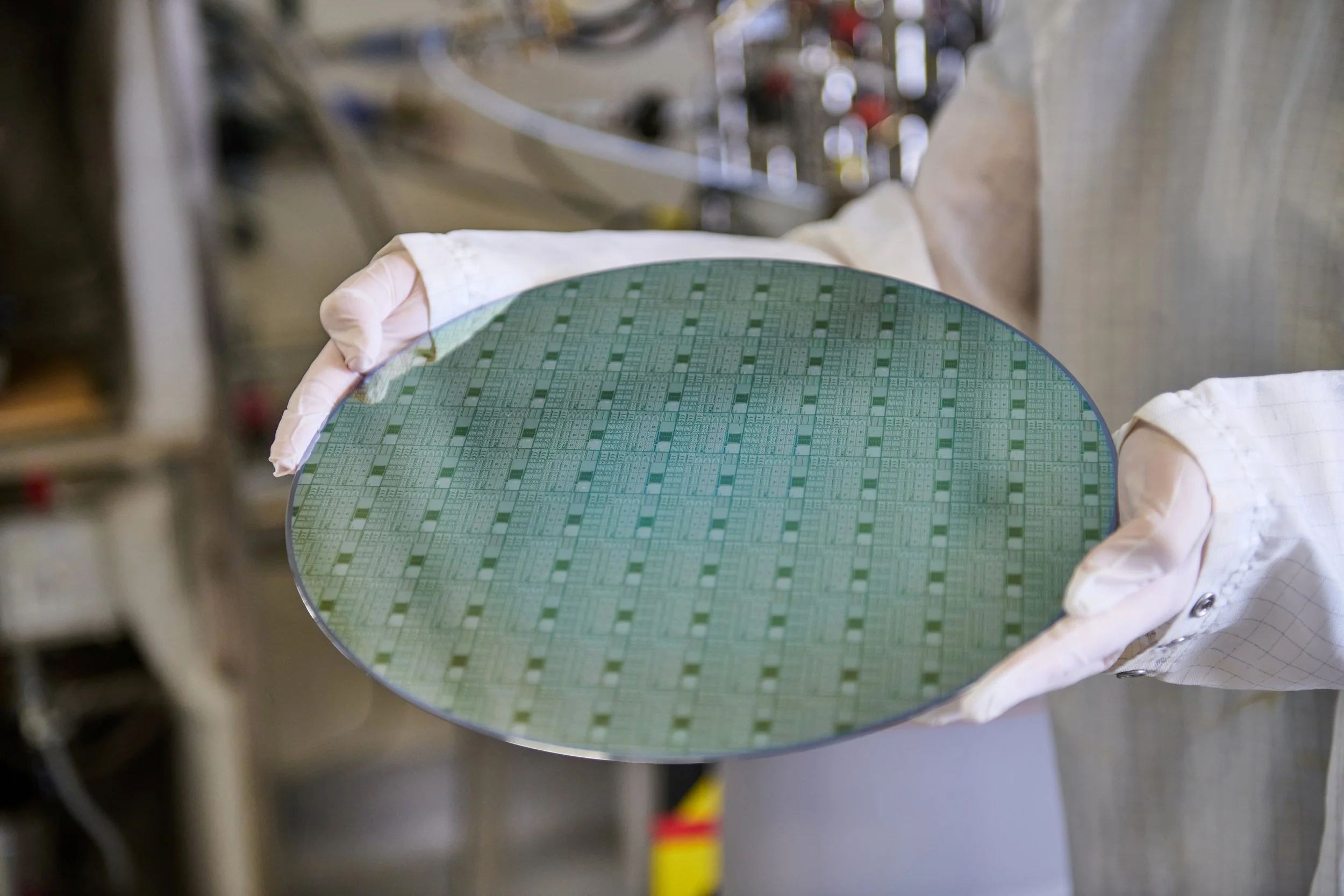
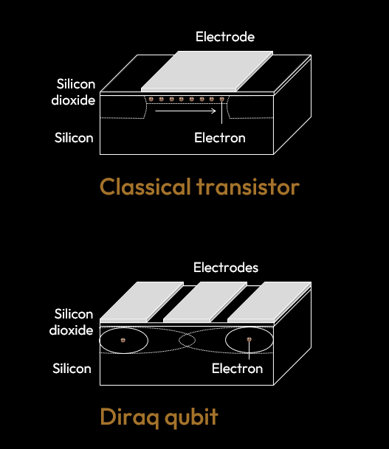
Silicon spin qubits sit on a different curve because each qubit is roughly the size of a transistor. Modern foundries produce classical processors with tens of billions of transistors on a single die, in volume, with yield economics that work. The manufacturing infrastructure to scale silicon qubits past one million therefore already exists, and the semiconductor industry has been paying for it for the past 50 years. The scaling question for silicon is not whether a standard foundry can produce the device. It’s whether the qubit physics holds up inside the manufacturing process — and this is the question that Diraq has spent two decades answering.

Each increase is intended to validate that the manufacturing process scales with the device, because that determines whether you can move from eight qubits to hundreds, then hundreds of thousands, and eventually millions without reinventing the underlying technology at every stage. Just as importantly, each step has to preserve the performance of the qubits themselves. Scaling only matters if the physics scales with it.

Deliberate, incremental progress on qubit count is part of the design. The goal is not simply to build larger arrays, but to demonstrate that scaling does not require a proportional increase in wiring, sensors or thermal overhead. Those engineering characteristics matter just as much as qubit count when the destination is millions of qubits on a single chip.

Scaling from a few qubits to a few million is tractable when every layer already sits inside the existing semiconductor stack. The tweaks to the classical design need to be reproducible, but this work determines whether you can make ten million qubits a few years after you make one million. Companies racing to be first to a hero number are optimizing for the headline. The question that matters to a long-term investor is which approach is still scaling in 2040. That depends less on today’s qubit count than on whether every increase makes the next one easier.

Silicon won a similar race to be the gold standard of classical computing because it kept getting better, predictably, for decades, and at a rate that the rest of the stack could plan against. The companies best positioned to ride that curve were the ones that came out on top. The same dynamic will play out in quantum. The timescale will be longer and physics slightly different, but the underlying logic is the same: manufacturing infrastructure compounds in ways that bespoke physics experiments do not. We covered how this principle applies to data center integration in Quantum is the Next Data Center Transition.

The question every investor should be asking

There’s a lesson here for investors who are evaluating the quantum computing space. The question to ask of every company is not just how many qubits it plans to have in five years, but what the roadmap looks like after that. A modality that reaches one million through heroic engineering and then plateaus is a worse long-term bet than one that takes longer to arrive but keeps soaring past the headline.

The first quantum computer to house one million qubits will undoubtedly be a milestone, and the impact of such a machine could change the world. But the industry won’t settle into its eventual shape until the qubit counts hit orders of magnitude past that mark. Recent results from Diraq, including the demonstration of an eight-qubit array fabricated in a commercial 300 mm CMOS process, are part of that longer story. They are less about the number of qubits than about establishing that the same manufacturing approach continues to work as arrays grow. What sets silicon apart is that the pathway to those scales is already being built out by the entire semiconductor ecosystem. The same manufacturing advances that will power classical chips a decade from now will compound directly into quantum performance, meaning that the silicon roadmap beyond ten million qubits is already being funded and developed externally.

No other modality can claim that leverage, and the modality with the manufacturing base to keep scaling is where the durable, trillion-dollar companies will be built.

Next
Next

Imec and Diraq demonstrate first coherent operation of eight silicon MOS spin qubits fabricated in a 300mm CMOS-compatible foundry process