Quantum's Fastest Path Runs on Proven Infrastructure

Every major computing revolution has required more than a breakthrough in physics or engineering. It has required an industrial ecosystem capable of turning laboratory demonstrations into products that can be manufactured, deployed, improved, and eventually taken for granted.

The internet needed fiber networks, cloud computing needed hyperscale data centers, artificial intelligence needed GPUs, software frameworks and global semiconductor supply chains. Technologies become transformative when the infrastructure around them becomes as important as the technology itself.

Quantum computing is usually discussed as though it will need to build that ecosystem from scratch. But, it won’t.

The quantum industry spends a great deal of time debating coherence times, qubit counts, and error correction schemes. Those are important questions, but they are only half of the scaling problem. The other half is industrial. Once a quantum architecture has shown that it works, the question changes from can it be built to can it be built millions of times? History suggests that this second question is usually the one that determines who ultimately wins.

The industrial lesson silicon taught us

The history of semiconductors is often told as though silicon was always the material used to build transistors. The reality was more complicated.

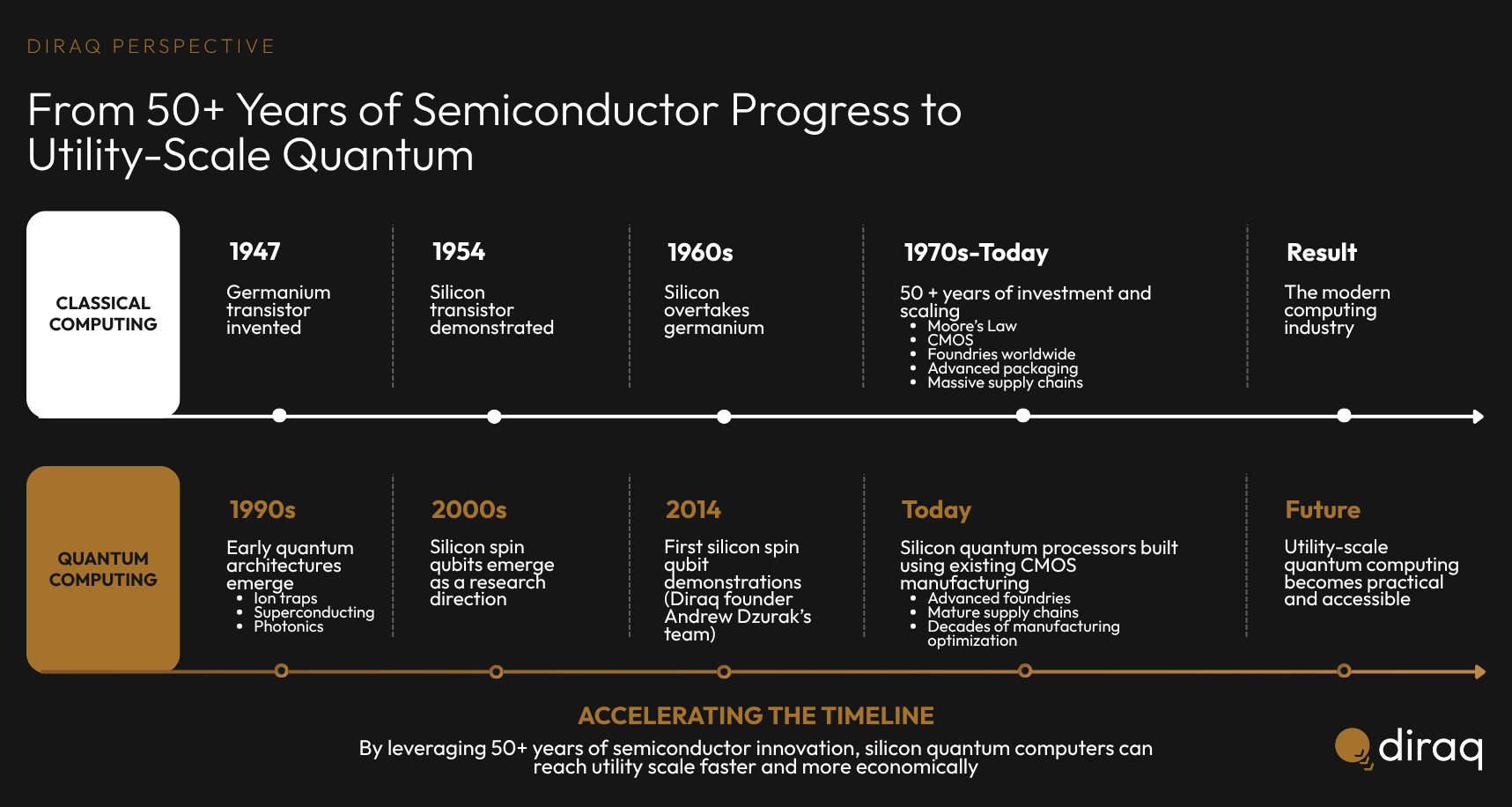
In the early 1950s, germanium was the dominant semiconductor. It powered transistor radios, military electronics, and the first generation of transistor computers. Manufacturing processes were improving quickly and commercial production was already underway. If you had asked an engineer in 1954 which material would dominate computing, germanium would have looked like the safer answer.

But the transition had already begun. Researchers started experimenting with silicon, not because it immediately produced better transistors, but because it possessed a manufacturing advantage that only became obvious with time. Unlike germanium, silicon naturally forms a stable oxide layer when heated. That oxide could be used both to protect the transistor and as a mask for patterning increasingly complex circuits onto a wafer. It was a seemingly small materials property that fundamentally changed what could be manufactured at scale.

Once that became clear, the industry reorganized around silicon. Germanium continued to have niche applications, but it no longer sat at the center of computing. The question had shifted from which material produced the best transistor to which material could support an entire manufacturing ecosystem.

Germanium disappeared because silicon made industrial scale possible.

It is easy to mistake today’s leading technology for tomorrow’s dominant platform. Computing history is full of examples where the technology that looked strongest in the laboratory was overtaken by the one that proved easier to manufacture, deploy, and improve over decades.

Quantum faces the same question

Quantum computing is approaching a remarkably similar moment.

Today, most discussions still focus on the hardware itself. How many qubits does a system contain? What fidelity has it achieved? Which modality has demonstrated the largest processor?

Those are sensible questions while the industry remains in its research phase. But, they become less useful once the conversation shifts toward utility scale.

A commercially useful quantum computer will require hundreds of thousands, and eventually millions, of physical qubits. At that point, every architecture faces a second challenge that receives far less attention. How do you manufacture those systems economically? How do you build supply chains around them? How do you integrate them into data centers? How do you improve them generation after generation without redesigning the entire industrial process?

Those are manufacturing questions rather than physics questions. They are also the questions that have historically determined which computing platforms become industries and which remain specialized technologies. Recent industry developments suggest this transition is already underway. IBM’s acquisition of HRL Laboratories highlights that the conversation is expanding beyond qubit performance alone to encompass the broader capabilities required to build and scale quantum systems, including manufacturing, packaging, cryogenics, and materials science. As quantum computing matures, the industrial ecosystem surrounding the hardware is becoming an important part of the technology itself.

The platform already exists

This is where silicon occupies a fundamentally different position from every previous computing revolution.

The semiconductor industry has already spent more than fifty years building the industrial platform that modern computing relies upon. Foundries, equipment manufacturers, process design kits, packaging technologies, design software, supply chains, and engineering talent have collectively become one of the largest manufacturing infrastructure ever created. Trillions of dollars have been invested in making silicon manufacturing more reliable, more repeatable, and more economical with every successive generation.

Almost no major computing company builds its own fabrication plants today. NVIDIA designs chips. TSMC manufactures them. Apple, AMD, Qualcomm and Broadcom all rely on the same industrial ecosystem. The industry separated chip design from chip manufacturing because it proved to be a more efficient way to scale innovation.

Quantum computing now faces a similar choice.

One option is to build entirely new manufacturing ecosystems around each quantum architecture. New fabrication techniques, specialist facilities, dedicated supply chains, and a workforce trained specifically for quantum hardware.

The other is to leverage the semiconductor ecosystem that already exists. As we’ve explored previously, CMOS compatibility is about far more than fabricating qubits on silicon. It means designing quantum processors that can take advantage of the manufacturing processes, tools and infrastructure the semiconductor industry has spent decades refining.

Those are very different paths. One asks the industry to recreate fifty years of semiconductor investment. The other starts with it.

Experience from the first silicon revolution

If quantum computing is entering an industrial phase rather than simply a scientific one, then experience scaling semiconductor businesses becomes surprisingly relevant.

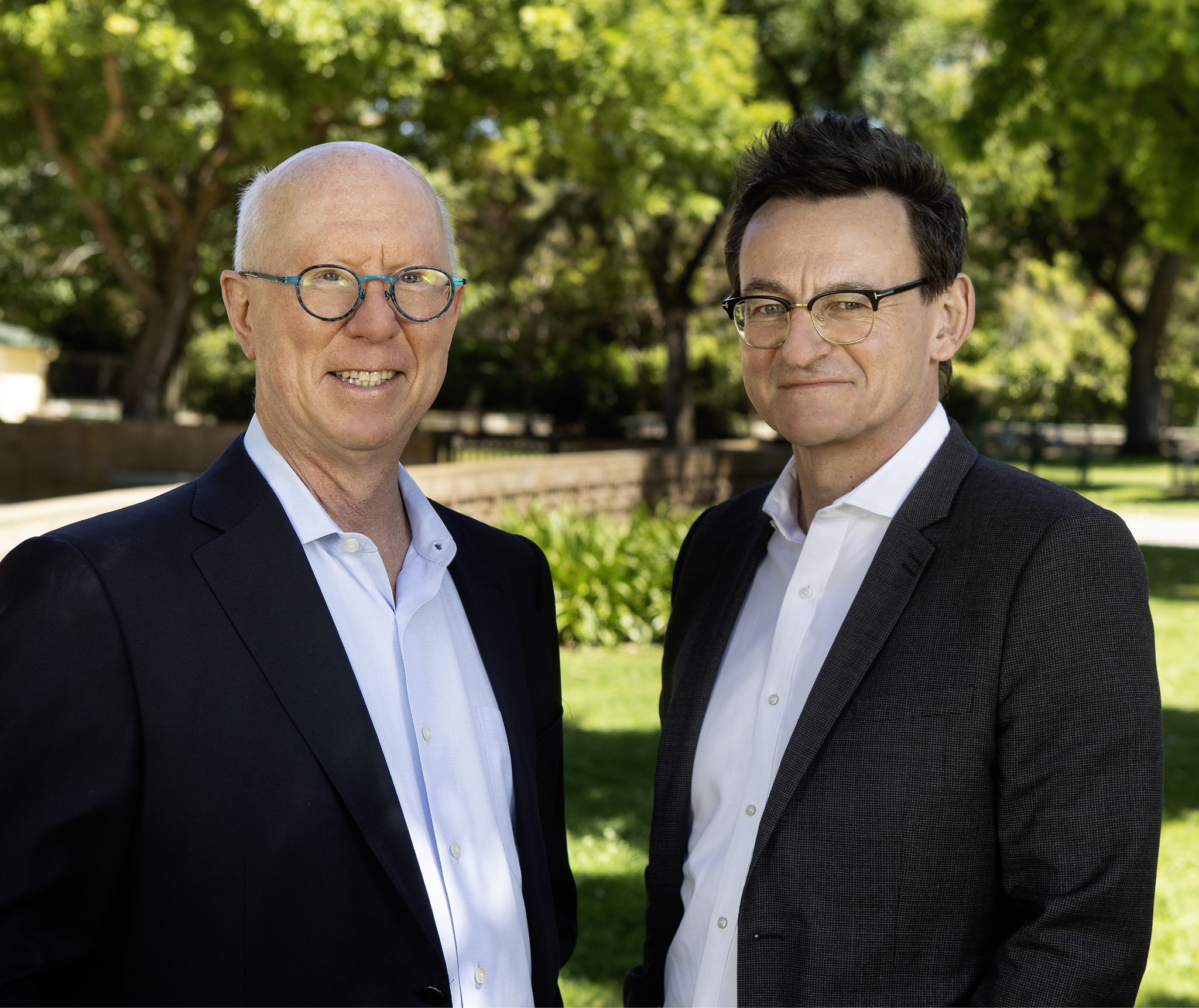
That is why Scott McGregor has joined Diraq as Chairman.

He worked at Xerox PARC and Microsoft as personal computing became mainstream. He led Philips Semiconductors and Broadcom during the rise of the fabless semiconductor industry, when designing chips became increasingly separated from manufacturing them. He later served on the boards of TSMC and Applied Materials, two companies that sit at the center of the manufacturing platform that powers modern computing.

That experience offers a different perspective on quantum computing.

Someone who has spent decades building semiconductor businesses naturally asks different questions. Not simply whether a technology works, but whether it fits into an ecosystem capable of supporting decades of continuous improvement. That is the transition quantum computing is beginning to make.

The next industrial revolution in computing

Much of the quantum industry is still competing to prove that its technology works. Over the next decade, the defining question will gradually become whether those technologies can become industries.

History suggests those are not the same thing.

Silicon transformed classical computing because it became the foundation of an industrial ecosystem that improved continuously for more than half a century. Quantum computing now has an opportunity that no previous computing revolution enjoyed. Instead of building that industrial machine from scratch, it can inherit one that already exists.

That is the opportunity Diraq has been designing for from the beginning. Because utility-scale quantum computing will be defined by the industrial platform capable of turning those breakthroughs into everyday computing infrastructure.

Quantum computing has undoubtedly inspired new physics, and will continue to require new engineering, and new breakthroughs. But it may not require a new industry. The industrial machine that transformed classical computing already exists. The work of building it has already been done. The bill has already been paid.

Next
Next

One Million Qubits Is Table Stakes