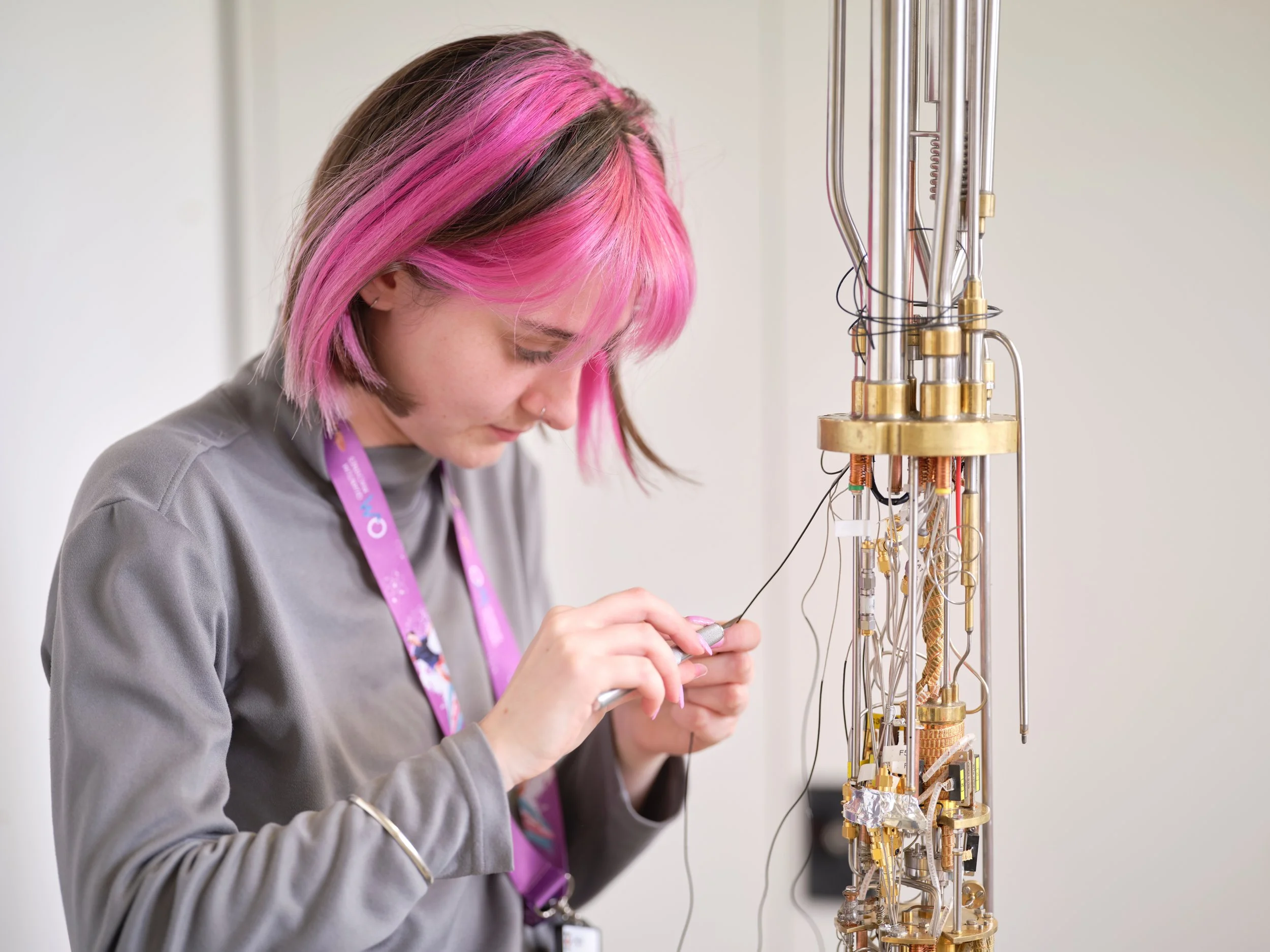
Alex Dickie was one of Diraq’s first hires and came to us with an undergraduate engineering degree and a firm desire not to pursue a PhD
What’s the best way of gauging the commercial readiness of the quantum computing industry? The obvious answer is to assess qubit counts and gate fidelities — the numbers that tell us how close we are to reaching utility scale. Those numbers matter, but there’s another signal that says something more fundamental about whether quantum is finally becoming an industry rather than a sustained science experiment: who are we hiring to get the job done?
For most of its short history, quantum computing has looked like an academic endeavor in commercial clothing. Job ads asked for a PhD as the minimum entry point, sometimes consciously, sometimes by default. That made sense in a field where every result was novel and every device a one-off. It does not make sense in a field that has now committed to delivering utility-scale machines by 2033.
The most telling indicator that quantum is industrializing is not the size of the latest funding round or the count of patents filed. It’s the fact that you can now walk through HQ at a quantum company and meet test engineers, measurement scientists, fabrication specialists, and quantum theorists who have never entertained the idea of getting a PhD. They are simply doing the work, and they are doing it well.
A PhD takes four to five years. Even if every quantum-adjacent doctoral program in the world ran at maximum capacity, and even if quantum were not competing with AI, biotech and semiconductors for the same physics and engineering talent, the pipeline could not meet that demand. To deliver useful quantum computers on the timeline that investors now expect, the industry has to look beyond academia for most of its workforce.
“A PhD student is there to do a research project and that doesn’t always line up with the work that needs to happen right now to build prototypes,” says Alex Dickie, an IC Test Engineer who joined Diraq after completing her undergraduate degree in engineering.
This is not to say that people with quantum-related PhDs won’t be in high demand. Some problems in quantum computing genuinely require deep, multi-year, problem-specific training, and PhD researchers will continue to do that work, which includes writing error-correction codes and designing qubit architectures, for example. But these people make up a small fraction of the headcount needed to design, fabricate, test, install, control and maintain millions of qubits worth of hardware.
What other deep-tech industries solved a long time ago
Quantum is far from being the first deep-tech industry to face this problem. The semiconductor industry is built on the same structural insight: a small number of PhDs come up with the device concept, then tens of thousands of engineers and technicians turn that concept into functioning systems. Walk any modern fab and the proportion of staff with doctorates is small. The factory floor at Bluefors, the world’s leading dilution-fridge manufacturer, looks much the same.
Quantum is not exempt from this structure. It’s overdue for it. The reason it has felt exempt for so long is that quantum computing has, until very recently, been almost entirely a laboratory pursuit. There were no products, only experiments, and experiments are run by researchers.
You don’t need to derive Hamiltonians to build a quantum computer
The cultural barrier here is the assumption that quantum hardware is so mysterious that everyone touching it must first master quantum mechanics. By that logic, the engineers who design and fabricate regular computer chips should all be able to solve the Schrödinger equation because that’s what governs the transport of charge carriers in their transistors. Granted, some of them probably can, but doing so wouldn’t make them better engineers. What the job really requires is an understanding of abstractions that hover one or two levels above the fundamental physics of the system.
Quantum is the same. You can be an outstanding test engineer in a quantum company — know what a qubit is, what a coherence time is, and how the readout chain feeds your instruments — without ever having derived a single matrix element. “You can do a lot of engineering in quantum computing that doesn’t require a PhD-level understanding of quantum physics,” says Dickie. You can be a great cryogenic technician without understanding the surface code. If quantum is going to scale, this kind of intellectual division of labor isn’t a compromise, it’s the whole point.
Alex Dickie was one of Diraq’s first hires and came to us with an undergraduate engineering degree and a firm desire not to pursue a PhD.
Cryogenics is the next trade
Cryogenics is a useful test case for where the industry is going. Today, almost every person operating a dilution refrigerator at a quantum company has a PhD. Not because the day-to-day work fundamentally requires one, but because cryogenics has historically had almost no commercial reason to exist outside research (MRI being the notable, and only partial, exception). The skill base lived in physics departments because that is where the freezers lived.
Quantum computing is arguably the first industrial application that needs a global, scalable cryogenic workforce. Within a decade, we should expect cryogenic installation and maintenance to look like climate control or industrial gas handling — a regular trade with its own certification and career ladder. The barrier is not technical complexity, it’s that the industry has to actually exist before formal training pathways can be built around it.
The world’s first Bachelor of Quantum Engineering
This is the context in which to read Diraq’s hiring. We have always operated on the conviction that the talent pool for quantum needs to be deliberately widened. This is not a cost-saving exercise, it’s necessary because no other staffing model can scale on the timeline we care about.
In 2020, UNSW Sydney launched its Bachelor of Quantum Engineering, a four-year undergraduate program designed to produce 40–50 engineers each year, who can walk into a quantum company and contribute on day one. Diraq’s Founder and CEO Andrew Dzurak was one of the architects of that curriculum, and Diraq is now hiring from the first cohort to graduate from it — including our Cryo Lab Support Engineer, Sophia Wolczak.
Engineering in Australia has long been a profession built around undergraduate training. Most Australian engineers enter the workforce after a four- or five-year undergraduate degree and build their expertise on the job. In other parts of the world, the norm skews the other way, and PhDs filter the candidate pool. This model works when labor isn’t scarce, but it won’t work in a global quantum scramble where every company is hiring at once.
A company that can only function with PhDs at every desk is a research project with a runway. A company that can hire comfortably across the full range of engineering and technical backgrounds is a business in the process of becoming an industry.
Diraq is hiring engineers, technicians and theorists across that range. We are doing it because the scale we are targeting cannot be reached any other way. Because silicon spin qubits are so close to the semiconductor industry that we can borrow its blueprints — for transistors, as well as for hiring. And because we believe that the path from intriguing science to deployable infrastructure runs through workforces, not just laboratories.
Quantum’s maturity test isn’t only what’s coming out of the fridge. It’s also who’s standing next to it.