Published in Physical Review Applied
Ssu-Chih Lin, Paul Steinacker, MengKe Feng, Ajit Dash, Santiago Serrano, Wee Han Lim, Kohei M Itoh, Fay E Hudson, Tuomo Tanttu, Andre Saraiva, Arne Laucht, Andrew S Dzurak, Hsi-Sheng Goan, Chih Hwan Yang
Abstract
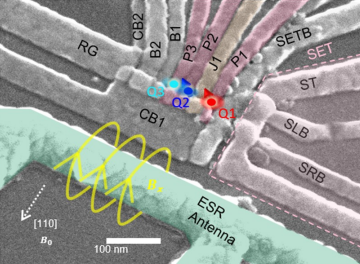
Spin shuttling offers a promising approach for developing scalable silicon-based quantum processors by addressing the connectivity limitations of quantum dots (QDs). In this work, we demonstrate high-fidelity bucket-brigade (BB) spin shuttling in a silicon MOS device, utilizing Pauli Spin Blockade (PSB) readout. We achieve an average shuttling fidelity of 99.8%. The residual shuttling error is highly sensitive to the ratio between interdot tunnel coupling and Zeeman splitting, with tuning of these parameters enabling up to a twenty-fold variation in error rate. An appropriate four-level Hamiltonian model supports our findings. These results provide valuable insights for optimizing high-performance spin shuttling systems in future quantum architectures.