Certifying the quantumness of a nuclear spin qudit through its uniform precession
Published in Newton
Arjen Vaartjes, Martin Nurizzo, Lin Htoo Zaw, Benjamin Wilhelm, Xi Yu, Danielle Holmes, Daniel Schwienbacher, Anders Kringhøj, Mark R van Blankenstein, Alexander M Jakob, Fay E Hudson, Kohei M Itoh, Riley J Murray, Robin Blume-Kohout, Namit Anand, Andrew S Dzurak, David N Jamieson, Valerio Scarani, Andrea Morello
Abstract
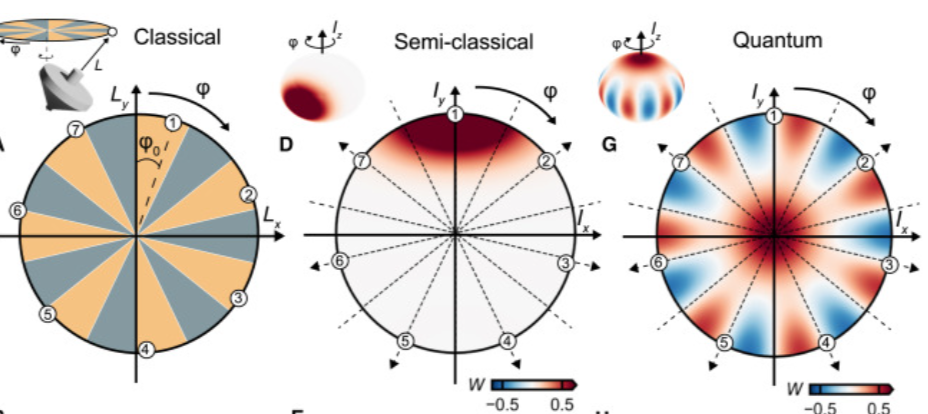
Spin precession is a textbook example of the dynamics of a quantum system that exactly mimics its classical counterpart. Here, we challenge this view by certifying the quantumness of exotic states of a nuclear spin through its uniform precession. The key to this result is measuring the positivity, instead of the expectation value, of the x-projection of the precessing spin, and using a spin >1/2 qudit that is not restricted to semi-classical spin coherent states. The experiment is performed on a single spin-7/2 123Sb nucleus, implanted in a silicon nanoelectronic device, amenable to high-fidelity preparation, control, and projective single-shot readout. Using Schrödinger cat states and other bespoke states of the nucleus, we violate the classical bound by 18 standard deviations, proving that no classical probability distribution can explain the statistic of this spin precession and highlighting our ability to prepare quantum resource states with high fidelity in a single-atomic-scale qudit.