Impact of electrostatic crosstalk on spin qubits in dense CMOS quantum dot arrays
Published in Physical Review B
Jesus D Cifuentes, Tuomo Tanttu, Paul Steinacker, Santiago Serrano, Ingvild Hansen, James P Slack-Smith, Will Gilbert, Jonathan Y Huang, Ensar Vahapoglu, Ross CC Leon, Nard Dumoulin Stuyck, Kohei Itoh, Nikolay Abrosimov, Hans-Joachim Pohl, Michael Thewalt, Arne Laucht, Chih Hwan Yang, Christopher C Escott, Fay E Hudson, Wee Han Lim, Rajib Rahman, Andrew S Dzurak, Andre Saraiva
Abstract
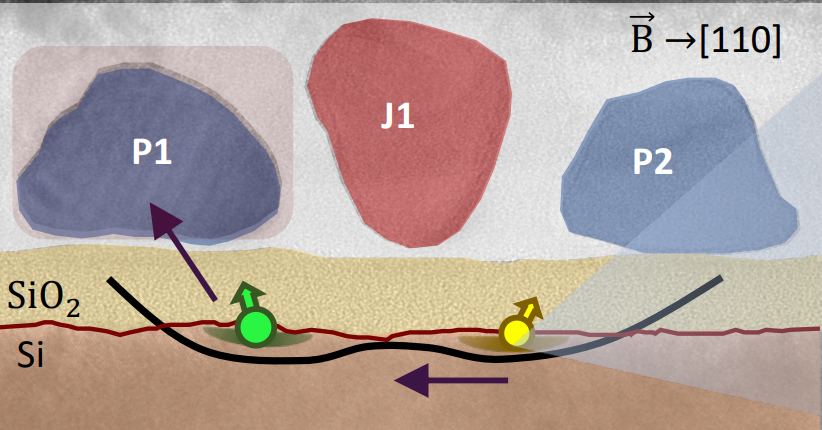
Current complementary metal-oxide semiconductor (CMOS) quantum processors employ dense gate arrays to define quantum dots, making them susceptible to crosstalk from capacitive coupling between the dots and the neighboring gates. Small but sizable spin-orbit interactions can transfer this electrostatic crosstalk to the spin factors, creating a dependence of the Larmor frequency on the electric field generated by gate electrodes positioned tens of nanometers apart. We study the Stark shift from tens of CMOS spin qubits measured in nine devices and develop a theoretical framework that explains how electric fields couple to the spin of the electrons in increasingly complex arrays. This includes electric fluctuations that limit qubit coherence times . The results will aid in the design of robust strategies to scale CMOS quantum technology.