Tomography of entangling two-qubit logic operations in exchange-coupled donor electron spin qubits
Published in Nature Communications
Holly G Stemp, Serwan Asaad, Mark R van Blankenstein, Arjen Vaartjes, Mark AI Johnson, Mateusz T Mądzik, Amber JA Heskes, Hannes R Firgau, Rocky Y Su, Chih Hwan Yang, Arne Laucht, Corey I Ostrove, Kenneth M Rudinger, Kevin Young, Robin Blume-Kohout, Fay E Hudson, Andrew S Dzurak, Kohei M Itoh, Alexander M Jakob, Brett C Johnson, David N Jamieson, Andrea Morello
Abstract
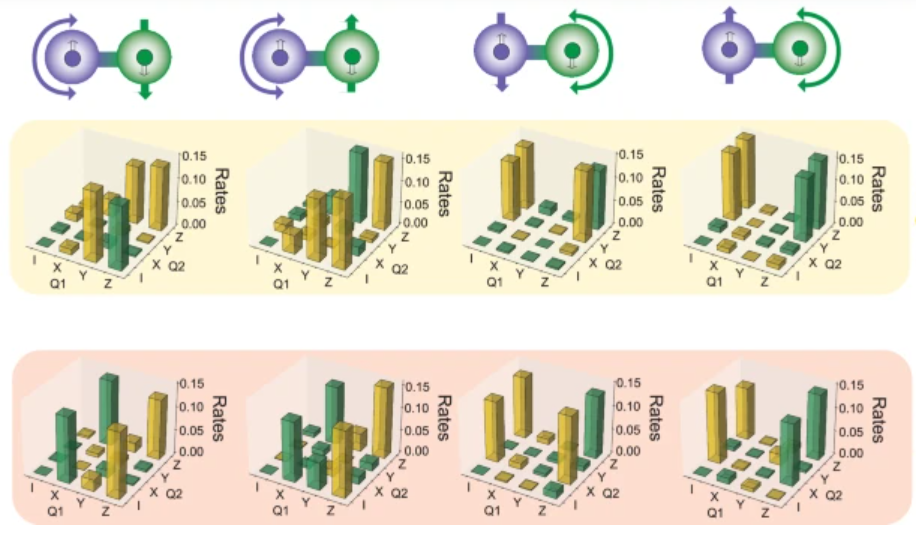
Scalable quantum processors require high-fidelity universal quantum logic operations in a manufacturable physical platform. Donors in silicon provide atomic size, excellent quantum coherence and compatibility with standard semiconductor processing, but no entanglement between donor-bound electron spins has been demonstrated to date. Here we present the experimental demonstration and tomography of universal one- and two-qubit gates in a system of two weakly exchange-coupled electrons, bound to single phosphorus donors introduced in silicon by ion implantation. We observe that the exchange interaction has no effect on the qubit coherence. We quantify the fidelity of the quantum operations using gate set tomography (GST), and we use the universal gate set to create entangled Bell states of the electrons spins, with fidelity 91.3 ± 3.0%, and concurrence 0.87 ± 0.05. These results form the necessary basis for scaling up donor-based quantum computers.