Schrödinger cat states of a nuclear spin qudit in silicon
Published in Nature Physics
Xi Yu, Benjamin Wilhelm, Danielle Holmes, Arjen Vaartjes, Daniel Schwienbacher, Martin Nurizzo, Anders Kringhøj, Mark R van Blankenstein, Alexander M Jakob, Pragati Gupta, Fay E Hudson, Kohei M Itoh, Riley J Murray, Robin Blume-Kohout, Thaddeus D Ladd, Namit Anand, Andrew S Dzurak, Barry C Sanders, David N Jamieson, Andrea Morello
Abstract
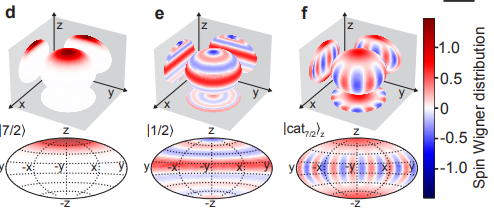
High-dimensional quantum systems are a valuable resource for quantum information processing. They can be used to encode error-correctable logical qubits, which has been demonstrated using continuous-variable states in microwave cavities or the motional modes of trapped ions. For example, high-dimensional systems can be used to realize ‘Schrödinger cat’ states, which are superpositions of widely displaced coherent states that can be used to illustrate quantum effects at large scales. Recent proposals have suggested encoding qubits in high-spin atomic nuclei, which are finite-dimensional systems that can host hardware-efficient versions of continuous-variable codes. Here we demonstrate the creation and manipulation of Schrödinger cat states using the spin-7/2 nucleus of an antimony atom embedded in a silicon nanoelectronic device. We use a multi-frequency control scheme to produce spin rotations that preserve the symmetry of the qudit, and we constitute logical Pauli operations for qubits encoded in the Schrödinger cat states. Our work demonstrates the ability to prepare and control non-classical resource states, which is a prerequisite for applications in quantum information processing and quantum error correction, using our scalable, manufacturable semiconductor platform.