
Key takeaways
● NVIDIA came out ahead in AI because its programmable cards were already ubiquitous when researchers found a killer application for them.
● Diraq is following the same trajectory by building quantum computers that are compact and economical enough to be deployed where they’re needed.
● Unlike other quantum compute technologies, Diraq’s systems will keep the same footprint and power envelope as they scale, meaning they’ll never outgrow practical deployment.
In 2012, three researchers at the University of Toronto took two NVIDIA graphics cards and used them to train a neural network called AlexNet.
The hardware was built for video games, but it went on to become the engine of modern computing, setting the wheels in motion for the AI era. This was partly because AI runs on much the same kind of math as 3D graphics, but also because NVIDIA had already made its cards programmable, and gamers had already put them everywhere. The cards were affordable and accessible, so the entry barrier to widespread use was startlingly low.
What NVIDIA had that its competitors didn’t was reach.
This is the game that quantum hardware providers should be playing, and it’s a big part of why Diraq homed in on silicon spin qubits. It’s also why Diraq sees NVIDIA as both a partner and a blueprint for how to change the world through compute.
Here’s the history lesson that maps out Diraq’s future.
How GPUs outgrew graphics
It was no accident that AlexNet was built on graphics cards. Drawing a scene in 3D means doing the same simple calculation on millions of pixels simultaneously, a task that can be split across the hundreds of processors inside a single chip. The calculations performed in AI mostly involve multiplying large matrices of numbers, millions of times, and this can be divided up in the same way.
That was good news for every company making graphics cards, not just NVIDIA, and the tech had already been marketed for applications beyond gaming. Researchers had been using graphics cards to run simulations of everything from fluids to folding proteins for the better part of a decade.
But in 2006, NVIDIA had launched CUDA, its general-purpose computing platform, and put it on every graphics card it sold, so every gamer who upgraded was unknowingly buying a programmable parallel computer. Before CUDA, using a GPU for general-purpose computation meant bending your problem into the shape of a graphics operation. After CUDA, you could write something close to ordinary code and run it across hundreds of cores.
By the time AI researchers needed enormous amounts of parallel computing power, NVIDIA's hardware was already on their desks, and they already knew how to use it.
What this means for quantum
Quantum computing is heading for its own 2012 moment. Once quantum systems have the qubit counts necessary to run useful algorithms, the applications will follow, including ones that nobody has thought of yet. That will be good news for every company building quantum computers, just as AI was good news for every graphics-card maker. But if NVIDIA's story is anything to go by, the first machine to get there won't necessarily be the one that matters most in the long term. It will be the one that's cheap to run, easy to access, and compatible with the tools that people already use.
That's why Diraq builds its hardware to connect with platforms the computing world already relies on. We use NVIDIA NVQLink to link our quantum processors with GPU compute, as well as CUDA-Q, NVIDIA's open platform for hybrid quantum–classical applications. Our partner Iceberg Quantum used NVIDIA CUDA-Q Logical to map its error-correction architecture all the way down to physical operations on Diraq's chips.
These connections make a Diraq processor one more part of a system researchers already know how to use.
Building the installed base
NVIDIA's cards were already on researchers' desks when AI took off because they were affordable and easy to install: a card that slotted into a computer people already owned. For quantum, the equivalent of the desk is the data center.
Plenty of quantum computers are already in data centers, but today's machines are a long way short of the millions of qubits needed for useful computing. And for most approaches, the hardware will grow with the qubit count: adding more qubits means building more modules and linking them together, which means that a utility-scale machine needs far more space than a data center can easily give it. Getting into the data center is easy when you're small. The hard part is staying there as you scale.
Diraq's trajectory runs the other way. Our first data center deployment takes up around 16 m2, but that's because it's an R&D system, with room for engineers to step inside the enclosure and reconfigure it. Once that access is no longer needed, the same system shrinks to around 5 m2.
Our qubits are made with the same manufacturing processes as ordinary computer chips, so millions of them can fit on a single chip. Scaling up means more qubits per chip, not more cryostats.
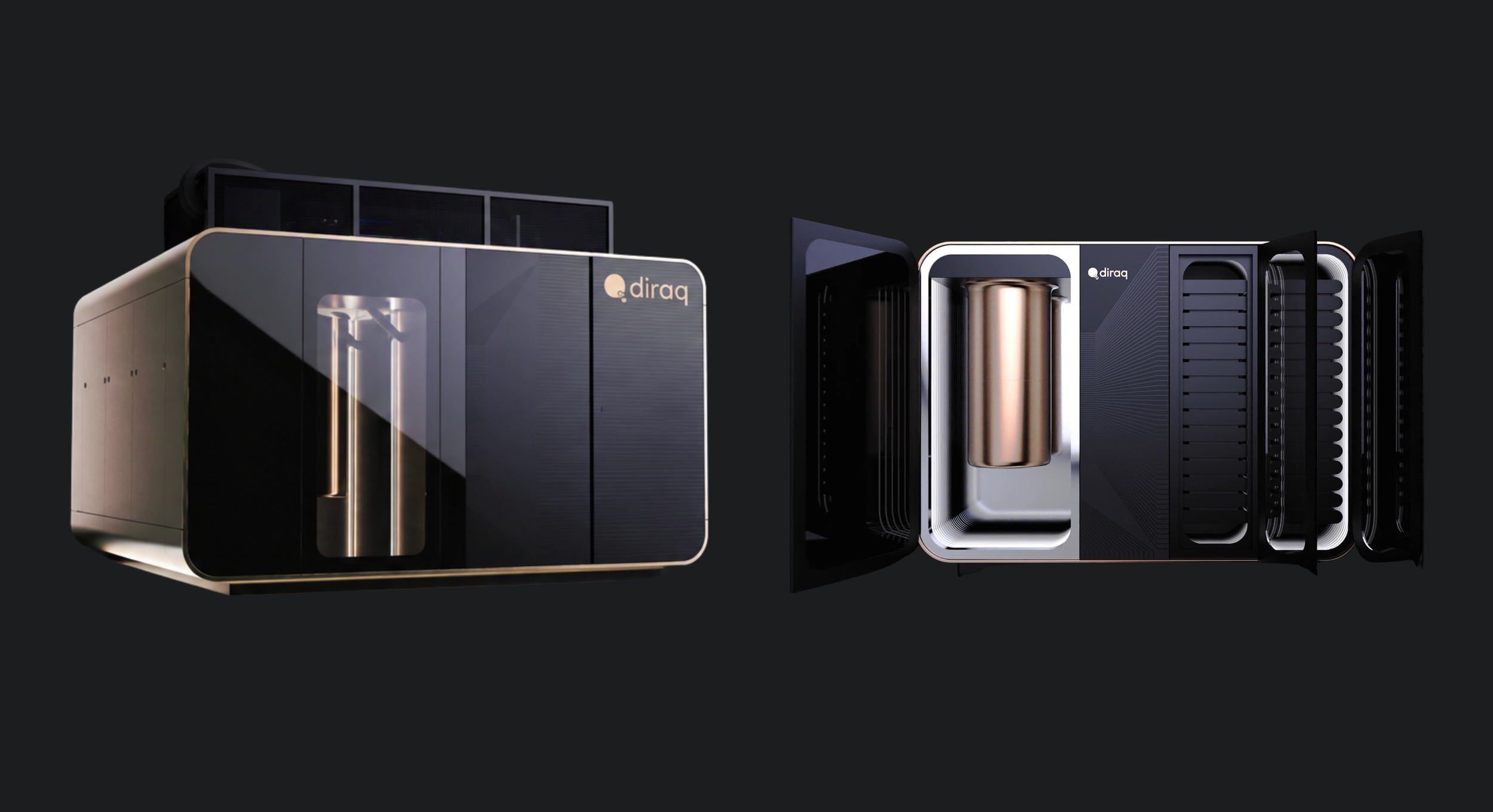
The Diraq prototype (left) being installed in an Equinix data center takes up around 16 m2, mainly to allow engineers easy access to all components during the company's R&D phase. The footprint of its utility-scale successor (right) will shrink to just 5 m2.
These design choices keep costs down and energy consumption low because one cryostat is cheaper to run and easier to power than a room full of them. But there’s another reason that Diraq’s systems can reach utility scale and still draw less power than a modern AI rack. Our qubits run at around one kelvin, roughly a hundred times warmer than many other qubit types, so they need far less cooling.
Error correction also has a role in keeping our systems compact: Diraq's work with Iceberg Quantum has given us a path to 1,000 error-corrected logical qubits from 150,000 physical qubits on Diraq's hardware, roughly ten times fewer than we had previously estimated. That could significantly reduce the hardware and energy required to deliver useful quantum computing.
Already on the desk
The AlexNet researchers didn't need a new kind of computer in 2012. They used the one already in front of them, and they already knew how to program it. Quantum's moment will come the same way. The systems that matter will be the ones researchers can access, developers can build on, and customers can integrate into their existing infrastructure. That's the foundation Diraq is building.